Off the Beaten Path: Visiting the Ancient Baobab Tree (The Elephant Tree)
Shehan De Silva
Travel Writer
You’ve explored the wild ocean for dolphins, conquered the wind on your kiteboard, and kayaked through the silent mangroves. But there is one more stop that every curious traveler in Kalpitiya must make a journey to see an ancient, mystical giant that should not even exist here.
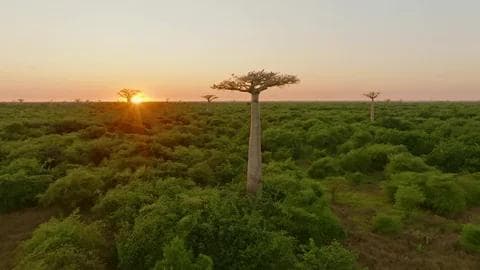
This is the Baobab Tree, known locally as the Ali Gaha, or the "Elephant Tree." It is a living, breathing artifact that has survived centuries, a silent witness to the history of the Arabian trade that once flowed through this coast. Its massive trunk and bizarre, upside-down appearance make it one of the most unique and humbling sights in all of Sri Lanka. It’s an easy, rewarding adventure for anyone seeking a true "hidden gem."
A Stranger in a Strange Land
The Baobab (Adansonia digitata) is native to the African mainland and Madagascar. So, how did a tree that belongs on the savannah end up thriving on the dusty plains near Kalpitiya?
The answer lies in the region's history as a critical global trading hub. It is widely believed that Arab traders and sailors, who frequented the harbors of Mannar and Puttalam as early as the 11th century, brought the Baobab seeds with them. The seeds were often carried for their medicinal properties, or perhaps the saplings were intentionally planted along their coastal trade routes to act as recognizable landmarks for future voyages.
Regardless of the exact reason, the Baobab is a historical anomaly. There are only about 40 surviving specimens in all of Sri Lanka, and the one closest to Kalpitiya is a magnificent, protected example, possibly hundreds of years old.
Why It Is Called the Elephant Tree
The tree earned the local nickname Ali Gaha (Elephant Tree) for two very obvious reasons:
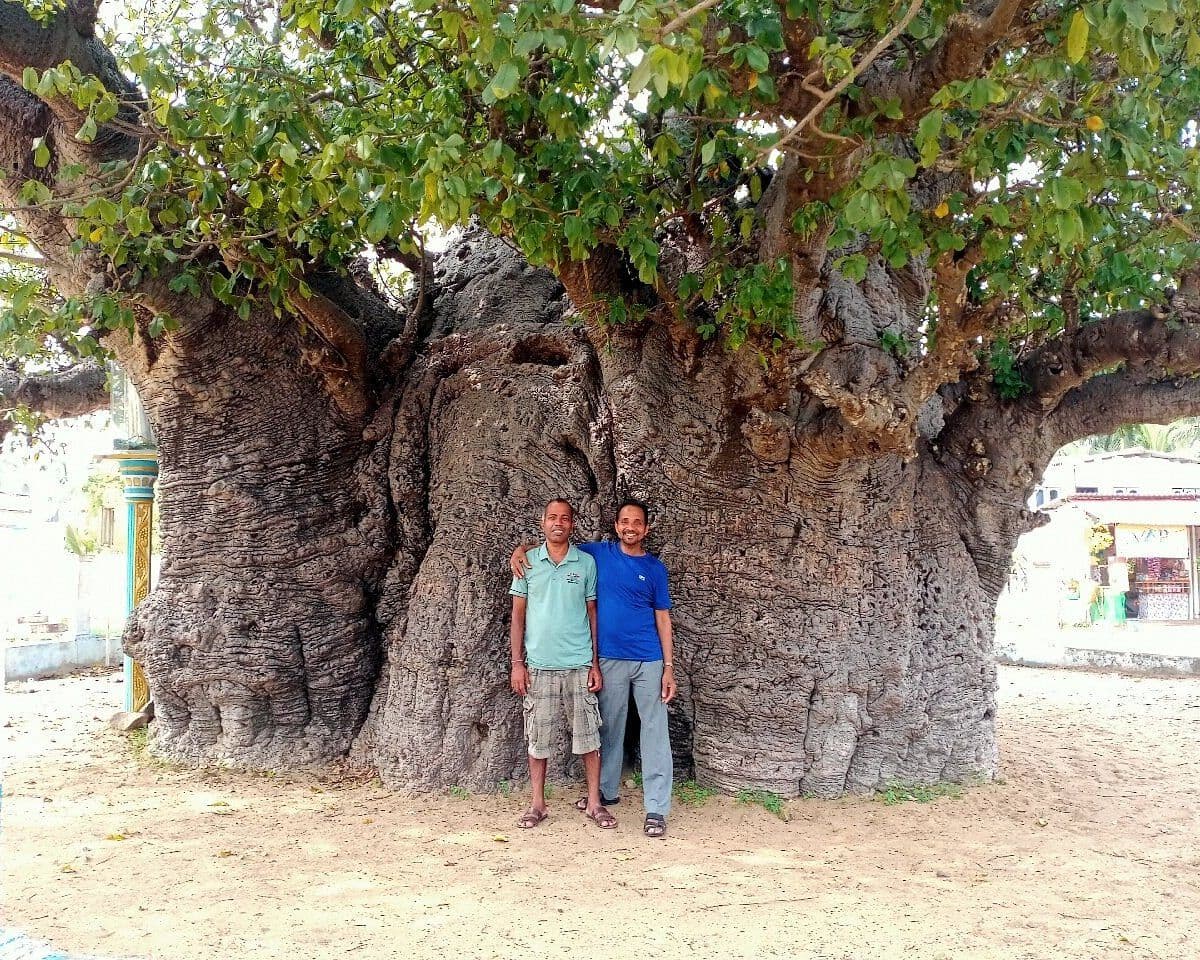
The Bark: The tree's bark is thick, rugged, grey, and wrinkled, bearing an uncanny resemblance to the hide of an elephant.
The Girth: Its sheer mass is astounding. Baobabs are designed to store water up to thousands of liters in their colossal, swollen trunks to survive the harsh dry seasons. This storage capability results in trunks so huge that it is often possible to walk inside them (though not recommended, and usually restricted for conservation).
Photographers love this tree because of its other nickname: the "Upside-Down Tree." When the Baobab sheds its leaves during the dry season, its bare branches spread out like tangled roots reaching for the sky, creating a silhouette that looks comically like a tree planted the wrong way up.
Finding This Hidden Gem (Realistic Logistics)
The most accessible Baobab for Kalpitiya visitors is typically found along the route toward the Eluwankulama entrance of Wilpattu National Park. This makes it an ideal, quick pit stop on your way to or from a safari.
Your Options for the Trip:
- The Quick Scooter Trip: If you are comfortable on a scooter, a fun afternoon trip involves following the Puttalam road north and cutting across to the Eluwankulama area. It is a straightforward route, but plan to go in the late afternoon to avoid the hottest part of the day.
- The Organized Boat Tour: Many eco-camps and resorts in Kalpitiya offer special sunset boat tours or extensions of the Wilpattu boat trip that specifically land near the Baobab at Pomparippu Aru. This is the most scenic way to approach the tree and guarantees a spectacular sunset view on your return journey across the water.
The visit itself is brief you will spend about 20 minutes walking around its base, taking photos, and soaking in the atmosphere. It is a moment of calm, geological awe, not a sprawling hike.
Final Thoughts
The Baobab Tree is a silent storyteller. It is proof that the history of Sri Lanka is woven with threads from Africa and Arabia, carried across the vast ocean by ancient mariners.
In a region dominated by adrenaline sports, the Baobab offers a moment of profound reflection. It is a mandatory pilgrimage for photographers, history buffs, and anyone who appreciates a unique roadside oddity. When you stand beneath its massive, sturdy trunk, you are touching history that spans seven hundred years. It is a humbling reminder that even the most "off the beaten path" finds can be the most memorable.
Enjoyed this story? Share it
About the Author
Shehan De Silva
A passionate coastal explorer and storyteller dedicated to uncovering world-class kitesurfing spots, hidden lagoons, and the vibrant marine life of Kalpitiya, Sri Lanka.